


Myomectomy or Hysterectomy? How to Choose if You Have Fibroids
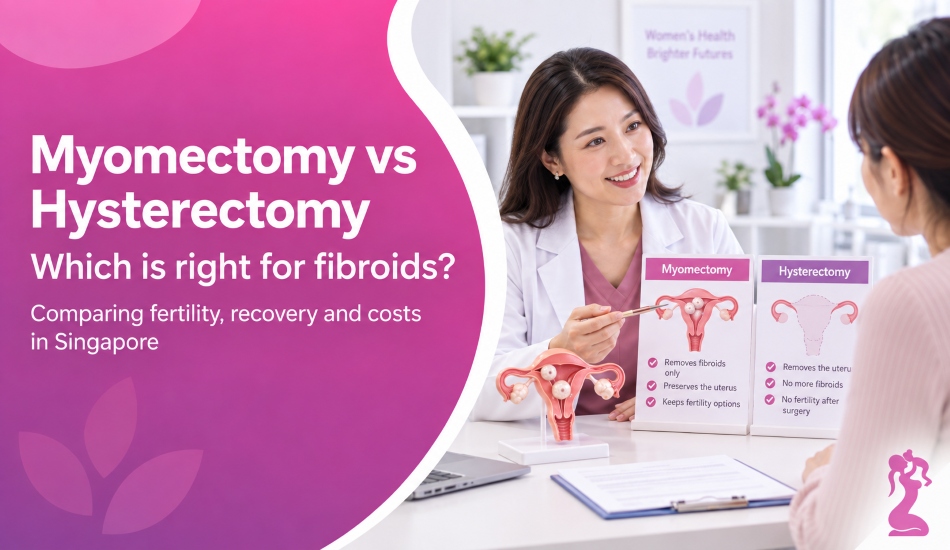
If you have fibroids and surgery has been raised, the choice is usually between a myomectomy, which removes the fibroids and keeps your uterus, and a hysterectomy, which removes the uterus entirely. Myomectomy preserves the possibility of pregnancy, but fibroids can return. Hysterectomy is permanent, and fibroids cannot come back, but it ends fertility. In Singapore, Ministry of Health data shows a hysterectomy in a private hospital actually has a higher median bill than a myomectomy, at $30,442 against $26,680, and usually a longer stay.
Most women are surprised by that last point. The assumption is that removing the whole uterus must be the simpler and cheaper operation. The figures say otherwise. This article explains what each operation involves, who each suits, what they cost in Singapore, and the questions worth asking before you decide.
What each operation actually does
A myomectomy removes the fibroids and leaves your uterus in place. The surgeon separates each fibroid from the uterine muscle and then repairs the uterine wall. It can be done by keyhole surgery, through the cervix, or as open surgery, depending on how many fibroids there are, how large they are and where they sit.
A hysterectomy removes the uterus. Depending on the type, the cervix may be removed as well, and in some cases the fallopian tubes and ovaries. If the ovaries are removed and you have not yet reached menopause, menopause begins immediately. If the ovaries are left, it does not.
One point that is often missed: myomectomy is frequently the more technically demanding operation of the two. The surgeon has to remove each fibroid individually and then rebuild the uterine wall so it stays strong enough for a future pregnancy. A hysterectomy removes the problem in one piece.
Who a myomectomy suits
Myomectomy is usually the right direction if any of the following apply to you:
- You want to be able to get pregnant, now or later
- You have not completed your family, or are not certain you have
- You want to keep your uterus for personal or cultural reasons, which is a legitimate reason on its own
- Your fibroids are limited in number and reachable
- You are some years away from menopause and want to avoid surgical menopause
The trade-off is honest and worth stating plainly. Fibroids can grow back after a myomectomy, because the uterus that grew them is still there. Some women go on to need a second procedure years later. Others never do.
At our clinic, many myomectomies are performed by keyhole surgery, including for larger fibroids that are sometimes treated with open surgery elsewhere. Whether that is possible in your case depends on the size, number, and position of the fibroids, which we assess on your scan before deciding.
When a hysterectomy makes more sense
A hysterectomy is often the better choice if:
- You have completed your family and do not want future pregnancies
- Your fibroids are numerous or very large, and a myomectomy would mean extensive reconstruction of the uterus
- Bleeding is severe and has not responded to other treatment
- Fibroids have already recurred after a previous myomectomy
- There is another condition present, such as adenomyosis or prolapse, that a hysterectomy also resolves
- You want certainty that the problem will not return
The advantage of a hysterectomy is that it is definitive. Fibroids cannot recur once the uterus has been removed. For a woman who has spent years managing heavy bleeding and repeated scans, that certainty carries real weight.
What each costs in Singapore
The figures below are published Ministry of Health bill benchmarks, based on actual transacted fees for Singapore Citizens. A “typical bill” is the median, meaning half of patients were charged less. Amounts include GST but come before any MediSave or insurance payout, so what you finally pay will be lower. Public hospital figures are already after government subsidies.
One note on which figures apply to you. The myomectomy column uses the benchmark for complicated cases, meaning fibroids over 5cm, more than two of them, or in a difficult position. If your fibroids are smaller and fewer, the simple myomectomy benchmark (SI709U) applies instead and the bill is lower. For hysterectomy, a keyhole assisted vaginal hysterectomy (SI718U) is benchmarked separately from the abdominal route used below.
Overall comparison
|
Setting |
Myomectomy, complicated |
Hysterectomy |
|---|---|---|
|
Public, Ward B2 (subsidised) |
$4,042 |
$3,951 |
|
Public, Ward B1 |
$12,822 |
$12,541 |
|
Public, Ward A |
$14,944 |
$15,696 |
|
Private hospital |
$26,680 |
$30,442 |
In subsidised public wards, the two are close. In private hospitals, the hysterectomy is the more expensive of the two, by roughly $3,800 at the median. The reason is straightforward once you see the stay lengths: a hysterectomy typically means about three days in hospital, a myomectomy closer to two and a half.
Private hospitals, side by side
Median bills by hospital, from MOH data for myomectomy (SI815U) and hysterectomy (SI712U).
|
Hospital |
Ward |
Myomectomy |
Hysterectomy |
|---|---|---|---|
|
Mount Alvernia |
2-bedded |
$20,207 |
$24,064 |
|
Mount Alvernia |
1-bedded |
$23,451 |
$25,934 |
|
Raffles Hospital |
1-bedded |
$25,433 |
$32,004 |
|
Thomson Medical Centre |
1-bedded |
$25,671 |
$28,701 |
|
Mount Elizabeth |
1-bedded |
Not published |
$32,467 |
|
Gleneagles |
1-bedded |
$32,443 |
$34,165 |
|
Mount Elizabeth Novena |
1-bedded |
$35,409 |
$37,214 |
Public hospitals
Subsidised figures are already net of government subsidy. Source: MOH benchmarks for SI815U and SI712U.
|
Hospital |
Ward |
Myomectomy |
Hysterectomy |
|---|---|---|---|
|
National University Hospital |
B2 (subsidised) |
$3,496 |
$3,704 |
|
Singapore General Hospital |
B2 (subsidised) |
Not published |
$3,849 |
|
KK Women’s and Children’s |
B2 (subsidised) |
$4,851 |
$4,440 |
|
KK Women’s and Children’s |
Ward A |
$15,607 |
$16,183 |
The hospital you choose matters more than the operation you choose
This is the part worth pausing on. Look at the private hospital table again. A myomectomy ranges from $20,207 at Mount Alvernia in a 2-bedded ward to $35,409 at Mount Elizabeth Novena in a single room. That is a difference of more than $15,000 for the same operation.
The gap between myomectomy and hysterectomy at the same hospital is usually two to four thousand dollars. The gap between hospitals for the same operation can be four times that.
Dr Law is accredited at seven private hospitals in Singapore, including Mount Alvernia, Thomson Medical, Gleneagles, Mount Elizabeth, Mount Elizabeth Novena, Parkway East and Farrer Park. That means the hospital is a decision you make, not one that is made for you. It is worth discussing openly at your consultation alongside your insurance plan.
The surgeon’s fee, and what MOH considers reasonable
In private care, the surgeon’s fee is billed separately from the hospital’s charges. MOH publishes recommended fee benchmarks so patients can see what a reasonable range looks like:
|
Fee |
Myomectomy (complicated) |
Hysterectomy |
|---|---|---|
|
Surgeon fee |
$7,848 to $11,772 |
$8,175 to $12,753 |
|
Anaesthetist fee |
$1,526 to $2,071 |
$1,962 to $2,834 |
|
Doctor’s daily attendance |
$230 to $450 per day |
|
All figures include GST. One detail worth knowing if you have several fibroids: MOH notes the myomectomy surgeon fee benchmark generally applies to cases of up to three or four fibroids removed by keyhole surgery, or up to eight by open surgery. Beyond that, the fee may reasonably be higher, and your surgeon should be able to explain why.
Both procedures sit in TOSP Table 5A, which determines your MediSave withdrawal limit. MediSave, MediShield Life and any Integrated Shield Plan you hold will reduce what you pay out of pocket, often substantially. Bring your policy details to your consultation.
Recovery compared
Recovery depends more on whether the surgery was done by keyhole or open technique than on the operation itself.
- Keyhole surgery. Usually two to three days in hospital. Most women are back to light activity within a week or two, and to full activity in about four to six weeks.
- Open surgery. Usually a longer stay and a recovery closer to six to eight weeks, with a larger scar.
After a myomectomy, if you are planning a pregnancy, your surgeon will usually advise waiting a period of months before trying, to allow the uterine wall to heal properly. How long depends on how deep the repair was. This is worth asking about directly, because it affects your planning.
Will fibroids come back after a myomectomy?
They can. The uterus that grew them remains, so new fibroids may develop over time. Recurrence is more likely if you had multiple fibroids to begin with and if you are still some years from menopause. It is less likely if a single fibroid was removed and you are closer to menopause.
This is not a reason to avoid myomectomy. It is a reason to be clear about what you are choosing. If keeping your uterus matters to you, a possible second procedure in ten years may be an entirely acceptable trade. If you want the matter settled permanently and your family is complete, hysterectomy delivers that.
Questions worth asking at your consultation
- Based on my scan, how many fibroids are there, how large, and where exactly are they?
- Can this be done by keyhole surgery, or would it need open surgery, and why?
- If I want to keep my uterus, is a myomectomy realistic in my case?
- What is the likelihood the fibroids return, given my age and how many I have?
- Which hospitals can you operate at, and what would each cost?
- Is the fee I have been quoted the surgeon’s fee, the hospital’s, or both?
- If I am planning a pregnancy, how long should I wait afterwards?
Deciding what is right for you
There is no single correct answer here. The right operation depends on your age, your fibroids, whether you want children, how severe your symptoms are, and how you personally weigh certainty against keeping your uterus. Two women with identical scans can reasonably choose differently.
If you would like to talk it through properly, you can read more about fibroid removal surgery at the clinic or arrange a consultation to go through your scan together.
Dr Law Wei Seng is an Obstetrics and Gynaecology Specialist at Mount Elizabeth Novena Specialist Centre with over twenty years of clinical experience and a particular focus on minimally invasive gynaecological surgery. You can read more about Dr Law.
Frequently asked questions
Is a myomectomy or hysterectomy cheaper in Singapore?
In private hospitals, a myomectomy is generally cheaper than a hysterectomy. MOH bill benchmarks put the median private hospital bill at $26,680 for a complicated myomectomy against $30,442 for a hysterectomy. In subsidised public wards the two are close, at roughly $4,000 each in Ward B2. The hysterectomy costs more mainly because the hospital stay is usually longer.
Can I still get pregnant after a myomectomy?
Yes, that is the main reason the procedure is chosen. Many women conceive after a myomectomy. Your surgeon will usually advise waiting a number of months before trying, so the uterine wall can heal. If you have had a deep repair, your obstetrician may also recommend delivery by caesarean section. Discuss both points before surgery if pregnancy is your goal.
Can fibroids grow back after surgery?
After a myomectomy, yes. The uterus remains, so new fibroids can develop, particularly if you had several to start with and are some years from menopause. After a hysterectomy, they cannot return, because the uterus has been removed.
Does a hysterectomy cause menopause?
Only if your ovaries are removed at the same time. If the ovaries are left in place, they continue producing hormones and menopause arrives naturally at the usual time. Your periods stop either way, because the uterus is gone. Ask specifically whether your ovaries are being removed, as it is not automatic.
Can MediSave be used for fibroid surgery?
Yes. Both myomectomy and hysterectomy fall under TOSP Table 5A, which sets the MediSave withdrawal limit for the procedure. MediShield Life and any Integrated Shield Plan may cover more, provided the surgery is assessed as medically necessary. Coverage varies by plan, so check with your insurer.
Medically reviewed by Dr Law Wei Seng, MBBS (Singapore), MRCOG (UK). Last reviewed September 2026.
This article is for general information and is not a substitute for personal medical advice. Cost figures are Ministry of Health bill benchmarks, are indicative, and change over time. Figures were last reviewed in September 2026. Confirm current amounts on the MOH website and confirm fees directly with your clinic, hospital and insurer.